Why AEO Is the New SEO for Shopify Brands

Most Shopify brands still treat Google rankings as the finish line. Their buyers have already moved the decision into ChatGPT, Claude, and Gemini, and they're asking those models which brand to buy before they ever see a search results page.
The behavior shift is no longer speculative. ChatGPT crossed 900 million weekly active users in February 2026, more than double the 400 million it reported a year earlier. On the shopping side specifically, an Adobe survey of U.S. consumers found 39% have used AI for online shopping, with 85% of those saying it improved their experience. The traffic follows: in the first three months of 2026, AI traffic to U.S. retailers rose 393% compared to a year earlier.
So the question for 2026 isn't whether AI search matters. It's whether your store gets named when a buyer asks an AI assistant "what's the best [product] in this category?" That question created a new discipline: Answer Engine Optimization, or AEO.
What AEO actually is
AEO is the practice of getting your brand surfaced inside AI-generated answers, not just ranked on a results page. The unit of competition has changed. The old goal was "rank #3 on Google." The new goal is "be the brand Claude names first when someone asks for a recommendation."
The mechanism is the reason this is a different discipline, not a rebranded one. Traditional search returns a ranked list of links and lets the buyer choose. An answer engine returns a single synthesized response built from sources the model trusts, and most buyers act on that one answer without clicking anything. You are no longer competing for a position on a page. You are competing to be inside the sentence the model generates.
That distinction has real consequences. SEO gets you listed. AEO gets you recommended. A brand can rank well on Google and still be completely absent from the answer ChatGPT gives, because the model isn't reading your meta tags, it's summarizing what credible sources say about you.
Why it matters more for Shopify brands than most
For ecommerce specifically, AI isn't just a research tool that sends people back to Google. It's increasingly the place the purchase decision gets made. Adobe's 2026 data shows 25% of customers now use AI platforms like ChatGPT as their top research tool, making them more popular than brand sites, reviews, or traditional media. Adobe
The buyers who arrive this way are worth more, not less. AI traffic converted 42% better than non-AI traffic in March 2026, a reversal from a year earlier when AI traffic converted 38% worse. Once a shopper lands on a retail site from an AI source, the engagement rate is 12% higher than non-AI traffic, and those shoppers spend 48% more time on the site. When the model recommends you, it sends a pre-qualified buyer who already trusts the recommendation. TechCrunchChain Store Age
The risk is the inverse of the opportunity. If a competitor is the brand the model names and you aren't, you don't get a lower ranking, you get nothing. There is no second page of an AI answer to be on. Either you're in the response or you're invisible for that buyer prompt, and you have no way of knowing it's happening unless you're measuring it.
How AEO differs from SEO in practice
SEO optimizes for a crawler: keywords, backlinks, metadata, page speed. AEO optimizes for a model that summarizes trusted sources: clear product clarity, editorial visibility, and consistent entity signals across the web. The two overlap, but the work that moves the needle is different.
LLMs don't run PageRank. They summarize sources they've learned to trust, and they corroborate claims across multiple places before putting your name in an answer.
That's why a single feature in a high-authority publication can ripple into hundreds of future AI recommendations, because the model treats that mention as evidence of who you are and what you make. A backlink from a low-trust directory does almost nothing here. A mention in a publication the model already trusts does a lot.
This is also why generic AEO checklists fail. Telling a brand to "add FAQ schema" without knowing whether the model already understands their catalog, or which competitor currently owns their key buyer prompts, is busywork. The signal you optimize for isn't position one. It's inclusion in the response, and inclusion is earned through structure the model can parse and sources the model already cites.
Five steps to get started
The work breaks into a sequence, and the order matters because each step depends on knowing the result of the one before it.
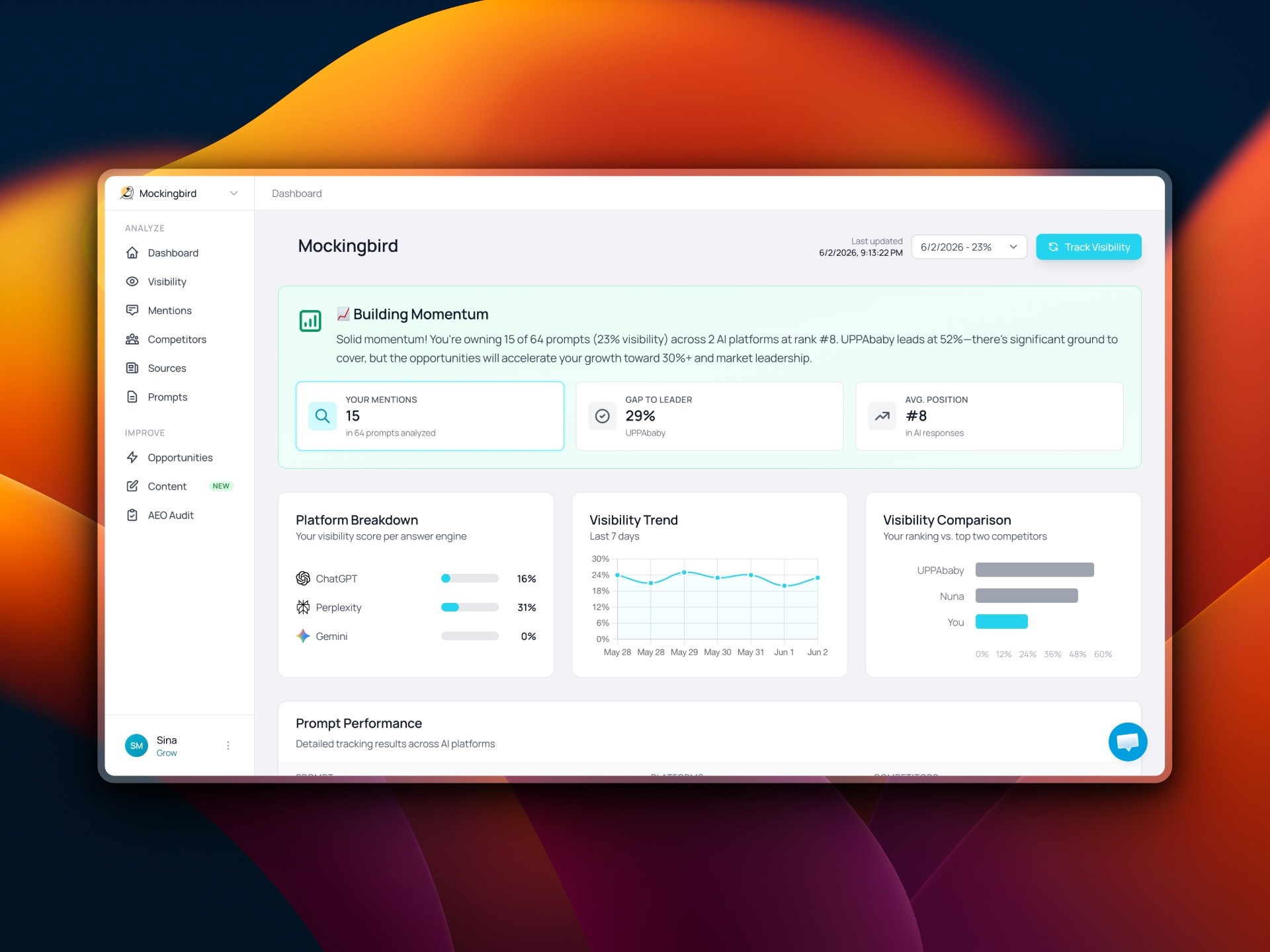
First, audit your AI visibility. Run the real buyer prompts in your category through ChatGPT, Perplexity, and Gemini and record whether your brand shows up, where, and which sources the model cites when it recommends someone. You can't fix a gap you can't see, and most brands have never actually looked.
Second, publish content the model can use. Clear product descriptions, detailed FAQs, and comparison pages framed as "why choose X over Y" map directly onto the questions buyers ask assistants, which makes them far more likely to get pulled into a recommendation. You're not writing for a crawler anymore. You're writing for a model that has to decide what to say about you.
Third, earn editorial and PR mentions. When ChatGPT recommends products, it frequently cites publications like Cosmopolitan, Forbes, and Marie Claire, because those outlets carry credibility the model has learned to trust. PR is now a visibility lever, not just a brand-awareness one, and consistent mentions across the right sources build the confidence a model needs before it names you.
Fourth, benchmark against competitors. Showing up isn't the goal. Outranking the competitor who currently owns the answer is. Track how often rivals get mentioned, which categories they appear in, and which sources the models cite for them, because that tells you exactly where the gaps are: the buyer prompts where a competitor gets named and you're absent.
Fifth, measure continuously. AI visibility isn't a one-time fix. Models update, citation sources shift, and competitors publish new content that changes who gets surfaced, so treat it as a metric you track over time, not a project you finish. In one anonymized clean beauty case, a brand increased its AI visibility 5x in 90 days by doing exactly this: measuring, fixing the highest-leverage gaps, and measuring again.
Where to start
This is the work CartRank does. You get a real visibility score, the specific competitor beating you on real buyer prompts, and a ranked list of fixes tied to the exact sources the models cite, not a 50-item SEO to-do list that ignores what you've already implemented.
Run a free visibility check and see where your brand shows up today when someone asks AI for the best in your category. It takes about a minute, and the prompts are generated for you. The brands winning in AI search aren't the ones with the most content. They're the ones who know which gap to close first.
Sources
https://almcorp.com/blog/chatgpt-900-million-weekly-active-users/